
Introduction
Generative AI is no longer a futuristic concept—it’s already transforming how we write code, create images, design products, and even compose music. From ChatGPT and GitHub Copilot to Midjourney and DALL·E, Generative Artificial Intelligence (GenAI) is reshaping industries at an unprecedented pace.
In this blog, you’ll learn:
- What Generative AI is
- How it works behind the scenes
- Real-world use cases
- Benefits, challenges, and future trends
- Why Generative AI skills matter in 2025 and beyond
💡 Why Generative AI Matters Today
Generative AI is rapidly becoming a must-have skill for developers, marketers, and business leaders. Companies are actively integrating AI into products, workflows, and decision-making systems—making AI literacy essential for career growth.
What Is Generative AI?
Generative AI refers to a class of artificial intelligence models that can generate new content—such as text, images, audio, video, and code—based on patterns learned from existing data.
Unlike traditional AI, which focuses on prediction or classification, generative AI creates something entirely new.
Examples of Generative AI:
- 📝 Text: ChatGPT, Claude, Gemini
- 🎨 Images: DALL·E, Midjourney, Stable Diffusion
- 💻 Code: GitHub Copilot, Amazon CodeWhisperer
- 🎵 Audio: MusicLM, Voice AI tools
How Does Generative AI Work?
Generative AI models are typically built using deep learning, especially transformers and neural networks trained on massive datasets.
High-level workflow:
| Step | Description |
|---|---|
| 1 | The model is trained on large datasets |
| 2 | Learns patterns, relationships, and structure |
| 3 | Receives a prompt from the user |
| 4 | Generates new content based on probabilities |

The most popular models today are Large Language Models (LLMs) like GPT, which use billions of parameters to understand and generate human-like responses.
Key Types of Generative AI Models
1. Large Language Models (LLMs)
Used for text generation, chatbots, summarization, and coding.
Examples: GPT-4/5, Claude, Gemini
2. Image Generation Models
Create realistic or artistic images from text prompts.
Examples: DALL·E, Stable Diffusion
3. Multimodal Models
Handle multiple data types like text + images + audio.
Examples: GPT-4o, Gemini 1.5
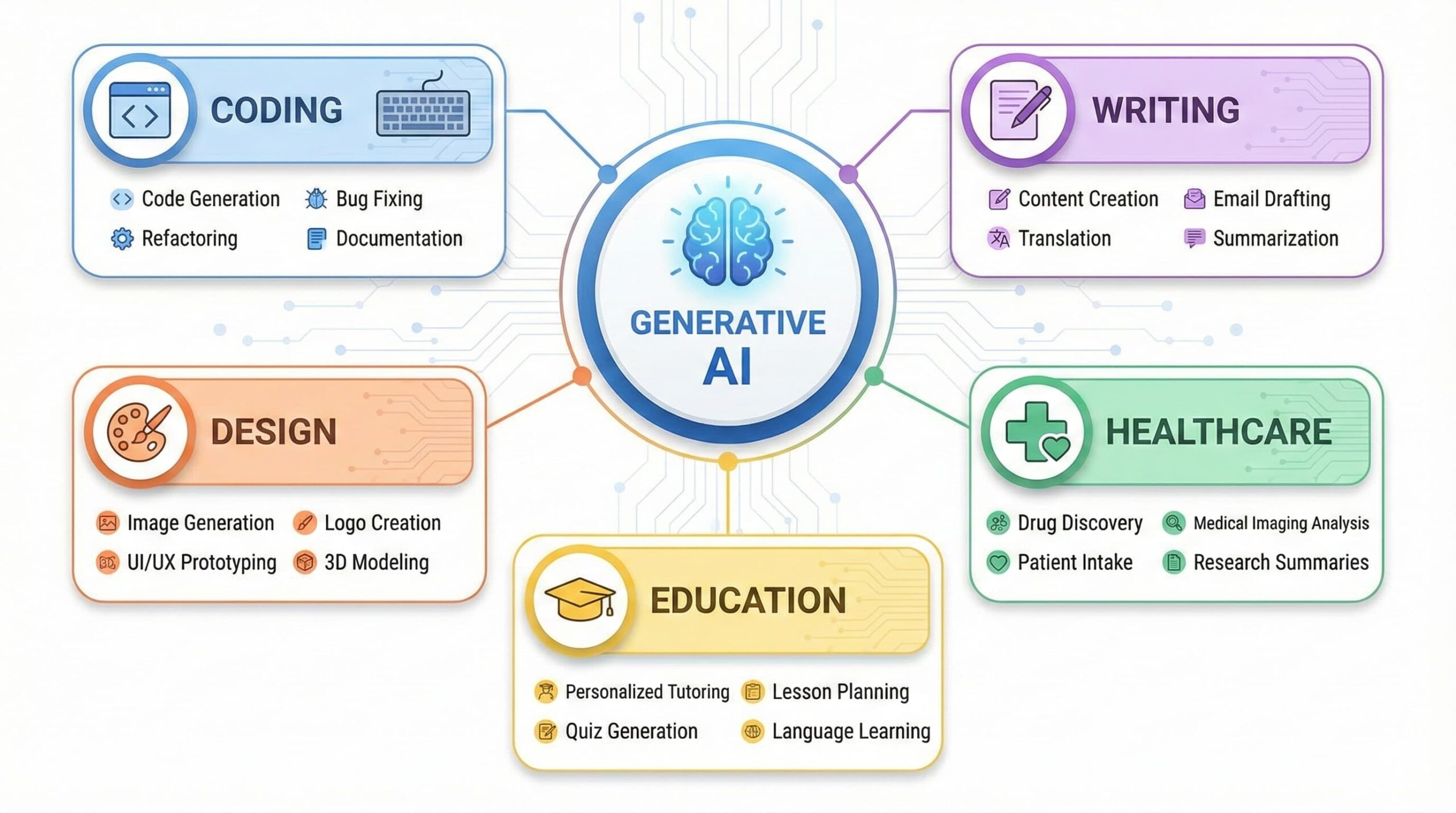
Real-World Use Cases of Generative AI
🚀 Software Development
- Code generation and refactoring
- Automated documentation
- Bug detection
📈 Business & Marketing
- Blog writing and SEO optimization
- Email and ad copy generation
- Social media content creation
🎓 Education
- Personalized learning assistants
- Automated explanations and summaries
🏥 Healthcare
- Medical report summarization
- Drug discovery research assistance
Benefits of Generative AI
✅ Boosts productivity
✅ Reduces manual effort
✅ Enhances creativity
✅ Scales content creation
✅ Accelerates innovation
Challenges & Risks of Generative AI
⚠️ Hallucinated or incorrect outputs
⚠️ Data privacy concerns
⚠️ Copyright & IP issues
⚠️ Bias in training data
⚠️ Over-reliance on AI
Tip: Always use human review for critical decisions.
Future of Generative AI (2025 & Beyond)
The next phase of Generative AI will focus on:
- Agentic AI (AI that can take actions)
- On-device AI
- Enterprise-grade security
- Industry-specific AI models
Generative AI will soon become a core skill, just like cloud computing or JavaScript.
FAQ: Generative AI
What is the difference between AI and Generative AI?
Traditional AI analyzes data, while Generative AI creates new content.
Is Generative AI safe to use?
Yes, but it should be used responsibly with human oversight.
Will Generative AI replace developers?
No. It will augment developers, not replace them.
References
- OpenAI – https://openai.com
- Google AI – https://ai.google