
Imagine opening your project management board on Monday morning and discovering that several tickets have already been completed, tested, documented, and submitted for review.
No, your team didn’t work through the weekend.
An AI software engineer did.
Just a year ago, developers were debating whether AI could write reliable production code. Today, leading engineering teams have moved beyond that question entirely. They’re assigning AI agents real engineering tasks and expecting results.
These autonomous coding agents can analyze requirements, understand repositories, write code, run tests, fix failures, update documentation, and create pull requests with surprisingly little supervision.
The most interesting part?
This isn’t about replacing software engineers. It’s about changing what software engineers spend their time doing.
Instead of getting buried in repetitive implementation work, developers can focus on architecture, product decisions, and solving complex business problems.
Let’s explore what that shift actually looks like.
📊 At a Glance: What AI Software Engineers Can Do Today
Before diving deeper, here’s a quick snapshot of what modern autonomous coding agents are already capable of:
| Capability | Status in 2026 |
|---|---|
| Generate Production Code | ✅ Mature |
| Understand Large Repositories | ✅ Mature |
| Write Automated Tests | ✅ Mature |
| Fix Common Bugs | ✅ Mature |
| Update Documentation | ✅ Mature |
| Design Complex Architectures | ⚠️ Human Oversight Needed |
| Make Product Decisions | ❌ Human Responsibility |
| Deploy to Production Independently | ⚠️ Limited Adoption |
💡 Reader Insight: Most organizations are not replacing engineers. They’re using AI to eliminate repetitive engineering work and increase team leverage.
From “Write This Function” to “Complete This Task”
Think back to the first AI coding tools.
They were incredibly useful, but they behaved more like smart autocomplete.
Developers still had to:
- Design the solution
- Write most of the implementation
- Create tests
- Debug issues
- Maintain documentation
Now consider this scenario:
You assign an AI agent the following task:
“Add OAuth authentication to our SaaS platform.”
What happens next?
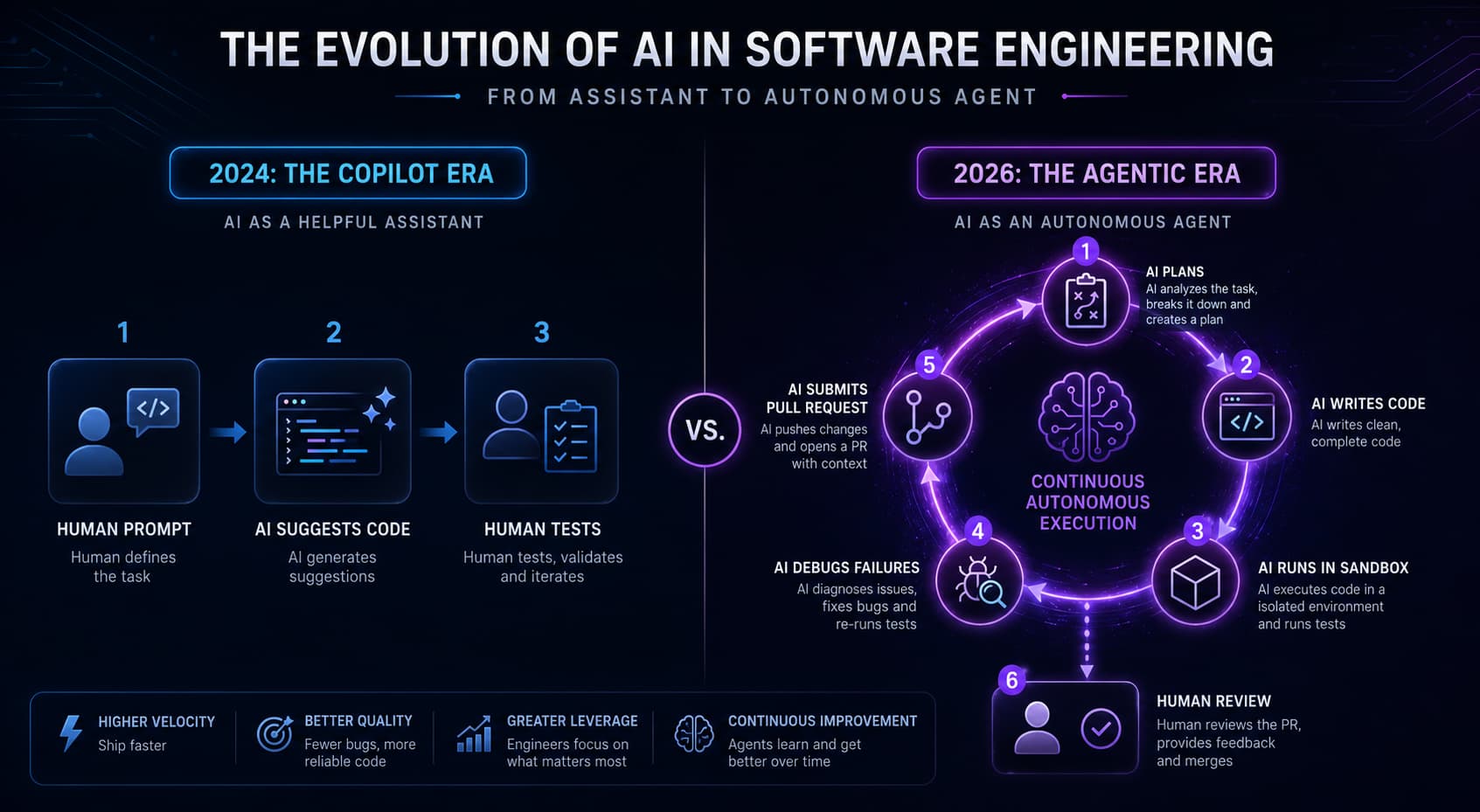
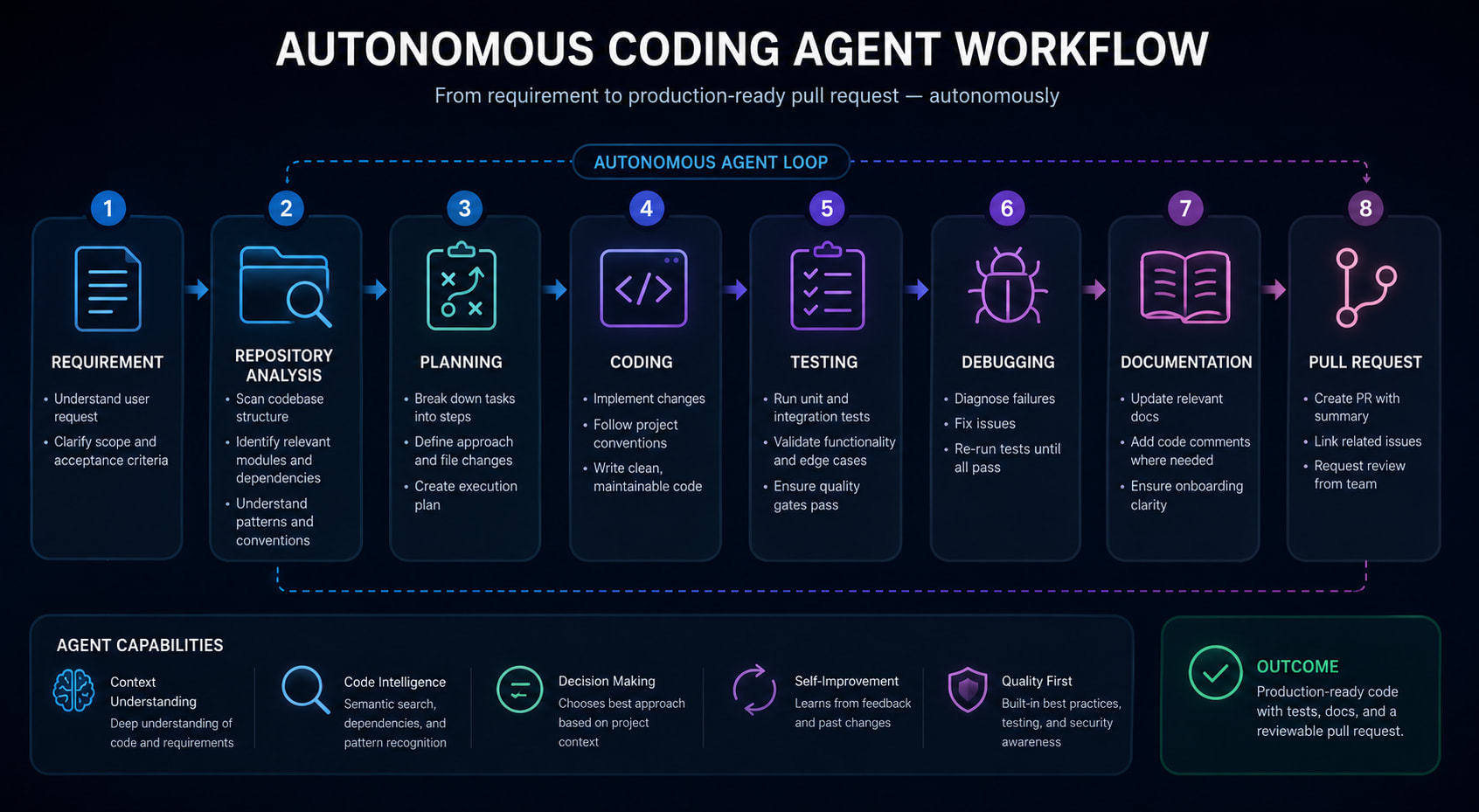
A modern autonomous coding agent might:
✅ Analyze the repository structure
✅ Identify authentication-related services
✅ Create an implementation plan
✅ Generate backend and frontend code
✅ Write automated tests
✅ Run validation checks
✅ Update documentation
✅ Open a pull request for review
Notice the difference?
You’re no longer asking AI to generate code.
You’re asking it to achieve an outcome.
That’s the moment AI starts behaving less like a tool and more like a software engineer.
Coding Assistant vs Autonomous Coding Agent
| Capability | AI Coding Assistant | Autonomous Coding Agent |
|---|---|---|
| Generate Code | ✓ | ✓ |
| Understand Entire Repository | Limited | Advanced |
| Create Multi-Step Plans | Partial | ✓ |
| Execute Tests | Limited | ✓ |
| Fix Failed Tests | Rarely | ✓ |
| Update Documentation | Manual Prompting | Automatic |
| Create Pull Requests | No | ✓ |
| Complete Tickets Independently | No | Increasingly Yes |
🤔 Quick Question: If an AI can complete 70–80% of a ticket independently, how should engineering teams redefine productivity?
Why Engineering Teams Are Embracing AI Agents
Software development has never been more complex.
Today’s teams juggle:
- Microservices
- Kubernetes clusters
- Cloud infrastructure
- APIs
- Security requirements
- AI integrations
Yet here’s the surprising reality:
Most developers spend far less time building features than people assume.
A large portion of engineering effort goes toward:
- Fixing bugs
- Updating dependencies
- Writing tests
- Reviewing pull requests
- Maintaining documentation
- Managing technical debt
Sound familiar?
These tasks are essential, but they’re rarely the reason developers became engineers.
This is exactly where autonomous coding agents shine.
Instead of replacing engineers, they’re removing the repetitive work that slows teams down.
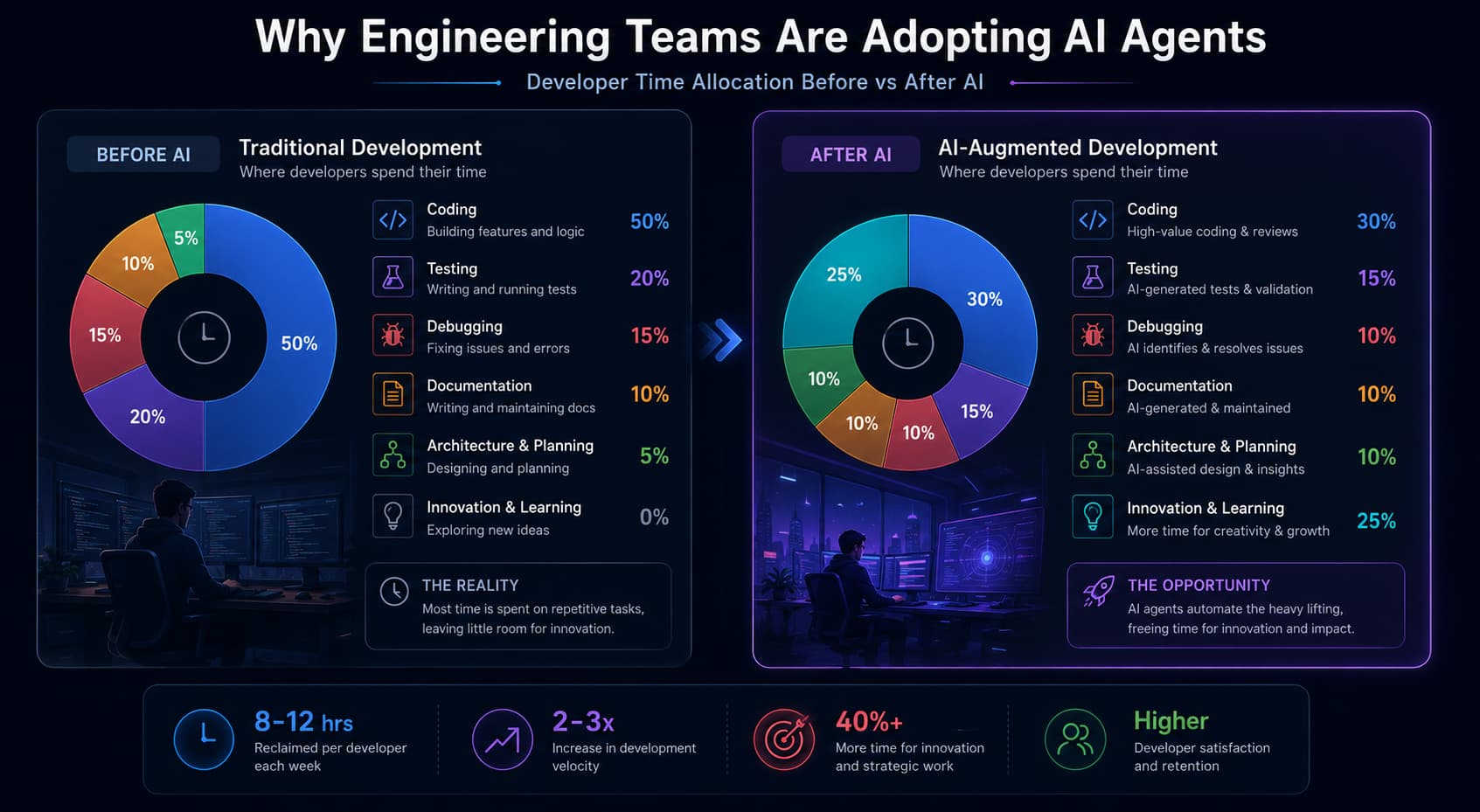
📌 Quick Stat Callout
Developers often spend less than half of their time building new features. The rest goes toward maintenance, debugging, testing, reviews, and documentation.
Use this as a highlighted quote box to improve engagement.
Where AI Software Engineers Deliver the Biggest ROI
Not every task should be automated.
But some areas are producing immediate and measurable results.
🧪 Automated Testing
Ask yourself:
How much time does your team spend writing tests?
AI agents can automatically generate:
- Unit tests
- Integration tests
- API tests
- Regression suites
The result?
Better coverage and fewer production surprises.
🔧 Technical Debt Reduction
Technical debt is like cleaning your garage.
Everyone agrees it needs attention.
Nobody wants to spend their weekend doing it.
AI agents can:
- Refactor legacy code
- Remove duplication
- Upgrade dependencies
- Improve maintainability
This allows teams to improve code quality without sacrificing feature velocity.
🐛 Faster Bug Resolution
Imagine receiving an alert at 2 AM.
Instead of waiting for an engineer to investigate, an AI agent can:
- Analyze logs
- Identify root causes
- Suggest fixes
- Validate solutions
- Create a pull request
We’re moving closer to software that helps repair itself.
📚 Documentation That Stays Updated
Let’s be honest.
Most documentation becomes outdated the moment it’s published.
AI agents can continuously update:
- API references
- Architecture diagrams
- Release notes
- README files
For many organizations, this alone creates significant productivity gains.
Human Engineers vs AI Software Engineers
| Activity | Human Engineer | AI Software Engineer |
| Strategic Thinking | Excellent | Limited |
| System Architecture | Excellent | Moderate |
| Coding Speed | Moderate | High |
| Documentation | Inconsistent | Consistent |
| Testing | Good | Excellent |
| Repetitive Tasks | Moderate | Excellent |
| Business Context | Excellent | Limited |
| Continuous Operation | No | Yes |
The takeaway?
AI isn’t replacing engineers.
It’s taking over the work engineers often wish they didn’t have to do.
The Teams Winning with AI Are Changing Their Workflow
Many organizations make the same mistake:
They treat AI as a productivity add-on.
The best teams do something different.
They redesign how work flows through the organization.
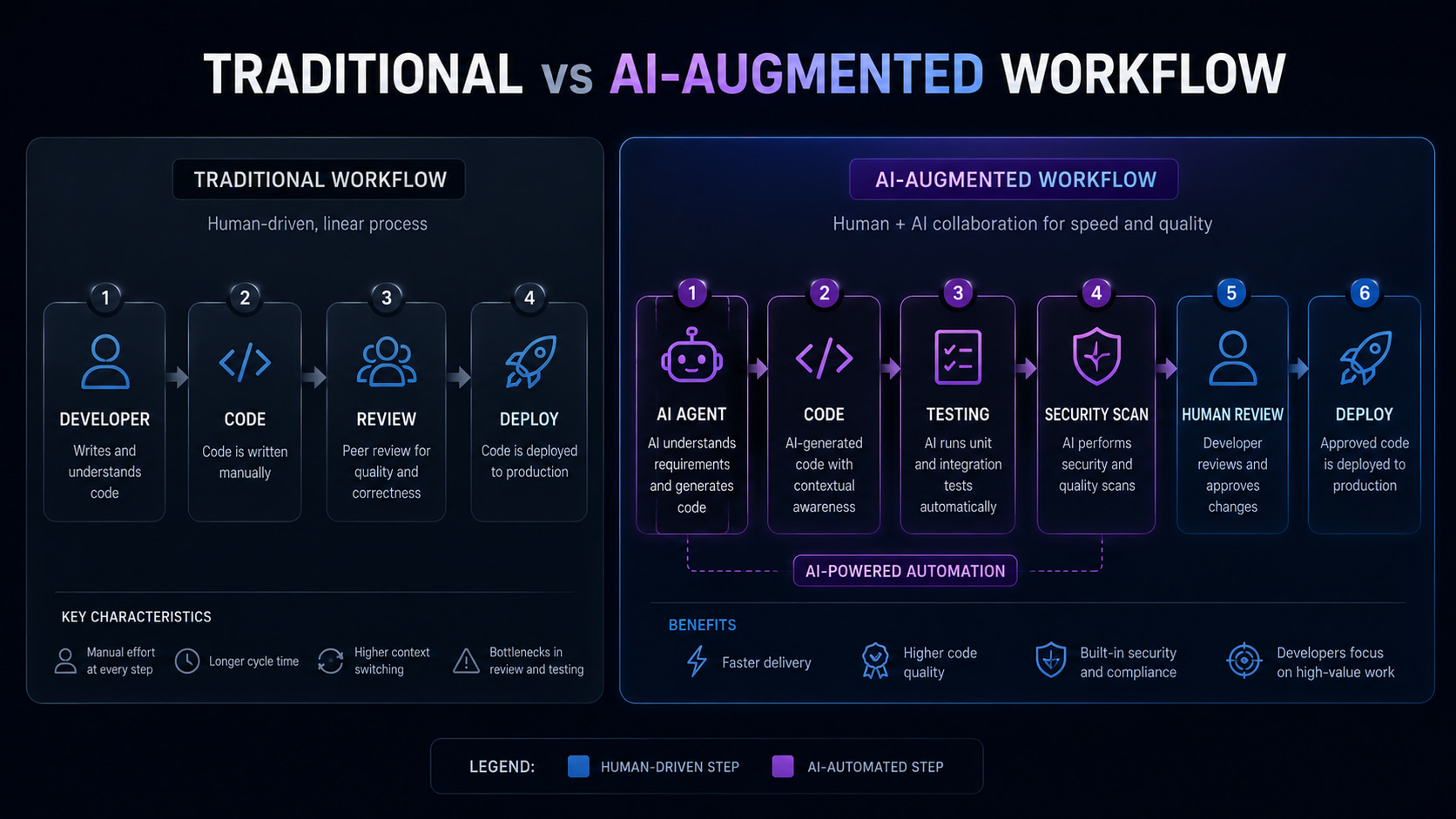
Traditional Workflow
👨💻 Developer → 💻 Code → 👀 Review → 🚀 Deploy
AI-Augmented Workflow
🤖 AI Agent → 💻 Code → 👨💻 Human Review → 🚀 Deploy
This simple shift changes everything.
Engineers spend less time implementing and more time evaluating, designing, and improving systems.
The result is leverage.
One experienced engineer can oversee work that previously required multiple contributors.
Expert Insight
The highest-performing engineers of the next decade won’t necessarily be the best coders. They’ll be the best AI orchestrators—people who know how to direct autonomous agents while maintaining quality, security, and business alignment.
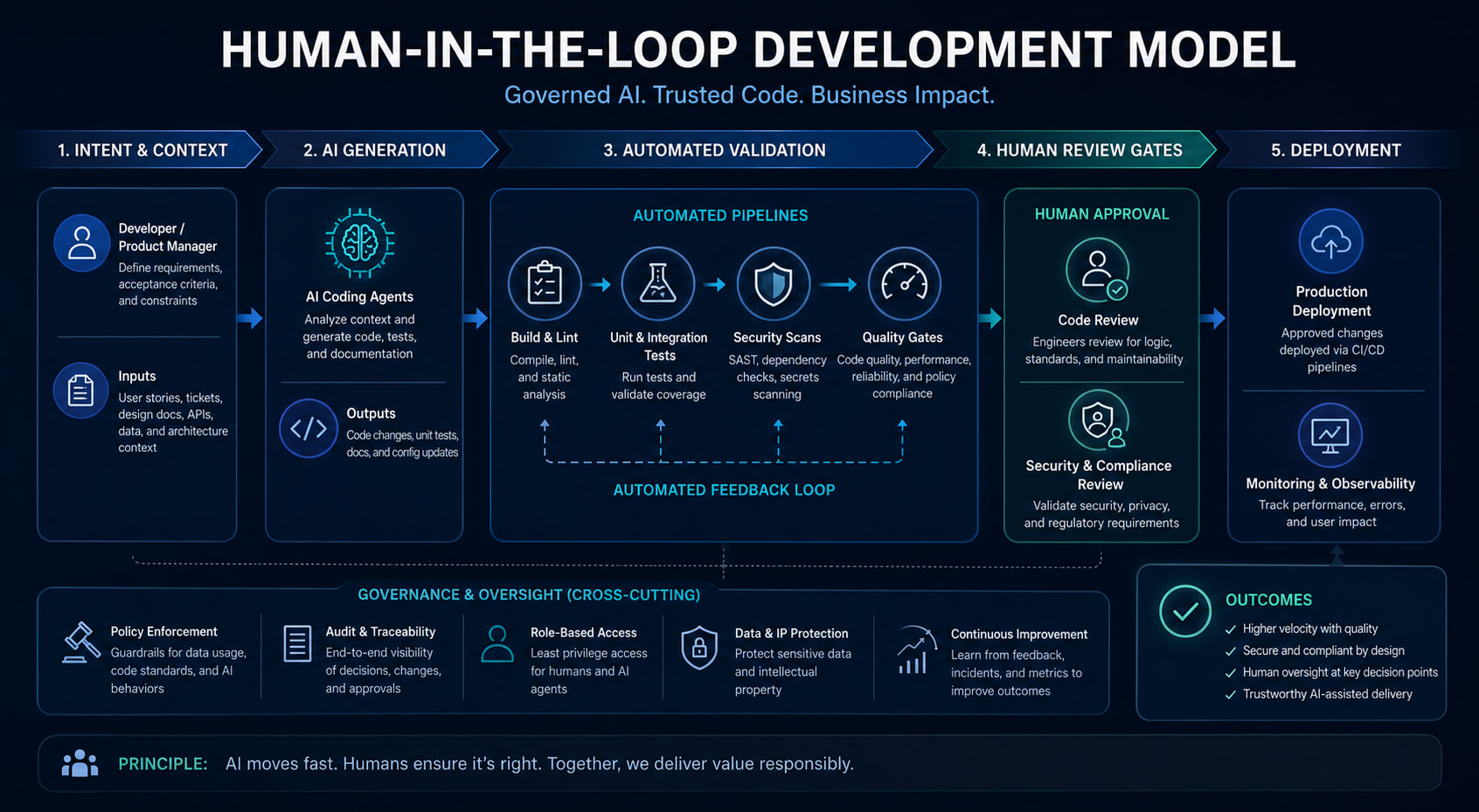
The Risks Nobody Should Ignore
Now for the reality check.
AI-generated code isn’t automatically good code.
In fact, autonomous agents can introduce:
- Security vulnerabilities
- Hallucinated implementations
- Architecture drift
- Compliance issues
- Hidden technical debt
Here’s the danger:
AI can generate mistakes just as quickly as it generates solutions.
That’s why successful organizations don’t pursue full autonomy.
They pursue supervised autonomy.
Leading teams implement:
✅ Human approval workflows
✅ Security scanning
✅ Automated code reviews
✅ Policy enforcement
✅ Continuous monitoring
Think of AI as a highly productive junior engineer.
You still need review processes.
You still need governance.
You still need accountability.
What Happens Next?
The future isn’t one AI engineer working alongside humans.
It’s an entire team of specialized AI agents.
Imagine a development organization that includes:
🤖 Development Agent
🧪 Testing Agent
🔒 Security Agent
📚 Documentation Agent
⚙️ Operations Agent
Each handles a specific responsibility while collaborating with human engineers.
In this world:
- AI executes
- Humans decide
- Teams move faster
- Quality remains controlled
The organizations that master this balance will have a significant competitive advantage.

Key Takeaways
✅ AI software engineers are evolving from code generators into autonomous task executors.
✅ The biggest gains come from testing, documentation, bug fixing, and technical debt reduction.
✅ Successful organizations redesign workflows instead of simply adding AI tools.
✅ Human oversight remains critical for security, quality, and governance.
✅ The future of software development is human-AI collaboration, not human replacement.
Conclusion
AI software engineers are no longer a futuristic prediction.
They’re already contributing to real engineering teams today.
The companies seeing the greatest impact aren’t replacing developers. They’re freeing developers from repetitive work so they can focus on architecture, innovation, and business outcomes.
The real question isn’t:
Can AI write code?
It’s:
How much engineering capacity can your organization unlock when AI starts handling the routine work?
The teams that answer that question first won’t just build software faster.
They’ll redefine how software gets built altogether.